
Synastry chart calculator: compare two birth charts, aspect by aspect
What happens between your two charts?
- Where it flows
- Where it rubs
- What you create
Your birth date and theirs. Birth time if you know it.
What a synastry chart shows
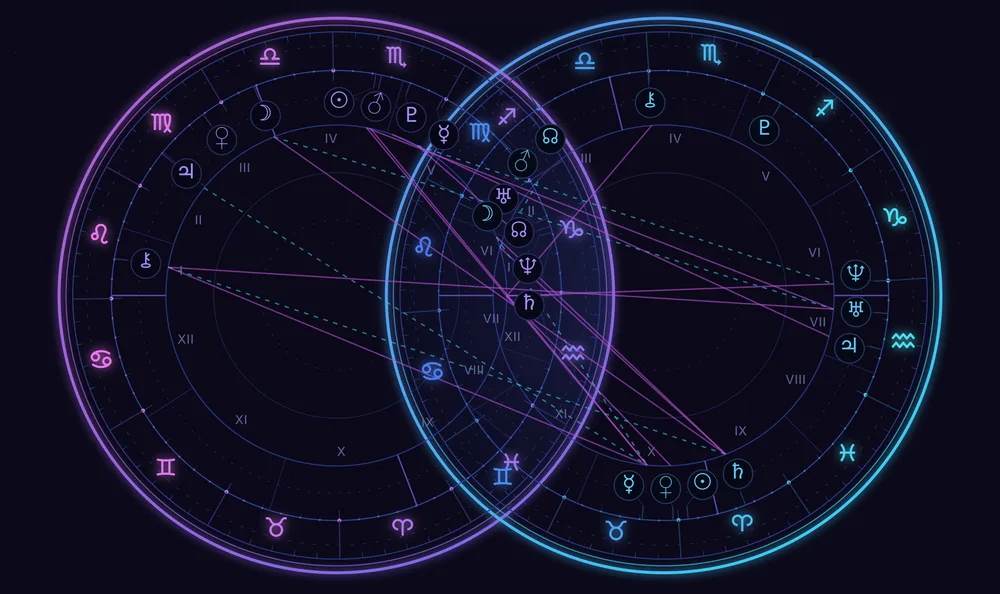
Synastry lays two birth charts over each other and shows how two people meet: where it flows between you, where it rubs, and what you create together.
Start with your own birth date right here. The other person — partner, friend, ex — comes next, and the app compares the two.
Does this sound familiar?
- You have the same argument every few weeks. Only the topic changes.
- One day you feel completely understood, the next not at all.
- You keep falling for people who stay a little out of reach.
- You'd like to know whether it's worth the effort, before you put in more.
Why couples fight about the same thing
The psychologist John Gottman, who has studied couples for decades, found that about 69% of conflicts in a relationship are perpetual problems: they come from differences in temperament and never fully go away. Couples who do well don't solve them. They learn to talk about them without contempt, sometimes even with humour.
So the question is rarely whether you have differences, because everyone does. It's which ones, and whether you can live with them.
Why we're drawn to people who are hard to reach
Research on attachment styles (the way we learned to look for closeness as children) has found that people with an anxious style and people with an avoidant style often end up together. One reaches out, the other steps back, and both feel the old familiar pull. It can feel like destiny. Often it's a pattern.
Psychology explains the pattern. Synastry shows where in your two charts it lives: which of your planets meet in tension, and which meet easily.
What a synastry chart shows
A synastry chart places the other person's planets around your birth chart. Two things are read from it:
- Aspects between the charts: angles between a planet of yours and a planet of theirs. A conjunction (both planets at almost the same point) merges them, an opposition (opposite sides of the circle) pulls them apart, a square (90°) creates friction, and a trine (120°) or a sextile (60°) lets things flow.
- House overlays: which of your houses (the twelve areas of life) their planets fall into. Their Venus in your seventh house touches partnership; their Saturn in your fourth touches home and family. This needs your birth time.
The contacts that matter most
- Sun – Moon: one person's will meets the other's need for safety. One of the classic signs of feeling at home with someone.
- Venus – Mars: attraction. What one of you finds beautiful meets what the other goes after.
- Moon – Moon: whether your emotional rhythms match: how each of you calms down, and what each needs after a hard day.
- Mercury contacts: how you talk, argue and understand each other.
- Saturn contacts: commitment and weight. Saturn gives a bond structure and time, and it can also feel like judgement.
- Pluto contacts: intensity, fascination, and questions of power.
- The lunar nodes: the feeling of a fated meeting, as if you had known each other before.
No single contact decides a relationship. What matters is how they add up, which is why the app reads whole areas, not individual lines.
Eight areas instead of one percentage
A single “78% compatible” tells you nothing. The relationship is broken down into areas that work on their own: partnership, attraction, communication, emotional safety, endurance, friendship, the sense of a fated meeting, and transformation.
On top of that comes friction — how much tension there is between you. Zero is not good news: a bond without friction tends to be calm, but not very alive.
Karmic synastry and the composite chart
The Karmic ties reading in AstroJung looks at one thing only: whether the lunar nodes or Pluto of one person meet a personal planet of the other in a conjunction or an opposition. Saturn and Chiron are read separately, as the places where the relationship asks something of you.
The reading can also end with “there is no classic karmic contact here”, and that is a full answer. A karmic tie is not a reason to stay, and it is not a promise.
The composite chart builds one chart from two: the relationship as a third being, with its own strengths and weak points. Synastry shows how you meet; the composite shows what you create together.
What else you can try
- Deeper readings of the relationship: how the other person sees you and what you awaken in them, how you argue and listen to each other, your emotional languages, who you see in the other person.
- When the sky touches your Venus and Mars — the days when relationships tend to move.
Questions people ask
Does a synastry calculator work without a birth time? Partly. Most aspects between the planets still hold, but the Moon may be off by several degrees, and the houses and the Ascendant cannot be calculated. The app says what it leaves out instead of guessing.
What is the difference between synastry and a composite chart? Synastry compares two charts side by side; the composite merges them into one chart of the relationship.
Can synastry tell whether a relationship will last? No. It shows where things come easily and where they take effort. What you do with that is not written in any chart.
What you need
The date, time and place of birth of both people. Without the time the houses cannot be calculated and synastry says less — the app tells you so and does not fill in what it doesn't know.
Your own chart needs no account. To add the second person and keep both charts, you create an account.
It is a map, not a verdict. It shows where things come easily between you and where they take effort. What do you already know about that effort?
What is free and what is in Pro
- not signed in: your chart and all the explanations
- signed in: synastry, matching, personalities, saved charts · readings — portrait, shadow, relationships, dreams, journal, chat, mirror, work and money — 1–3× to try
- Pro: readings — portrait, shadow, relationships, dreams, journal, chat, mirror, work and money — no limit
Pro is 9 € a month or 90 € a year. Pricing →